Cold Chain Monitoring and IoT: A Complete Guide to Devices, Technologies, and Solutions
Cold Chain
Feb 25, 2025 • 6 min read
TL;DR
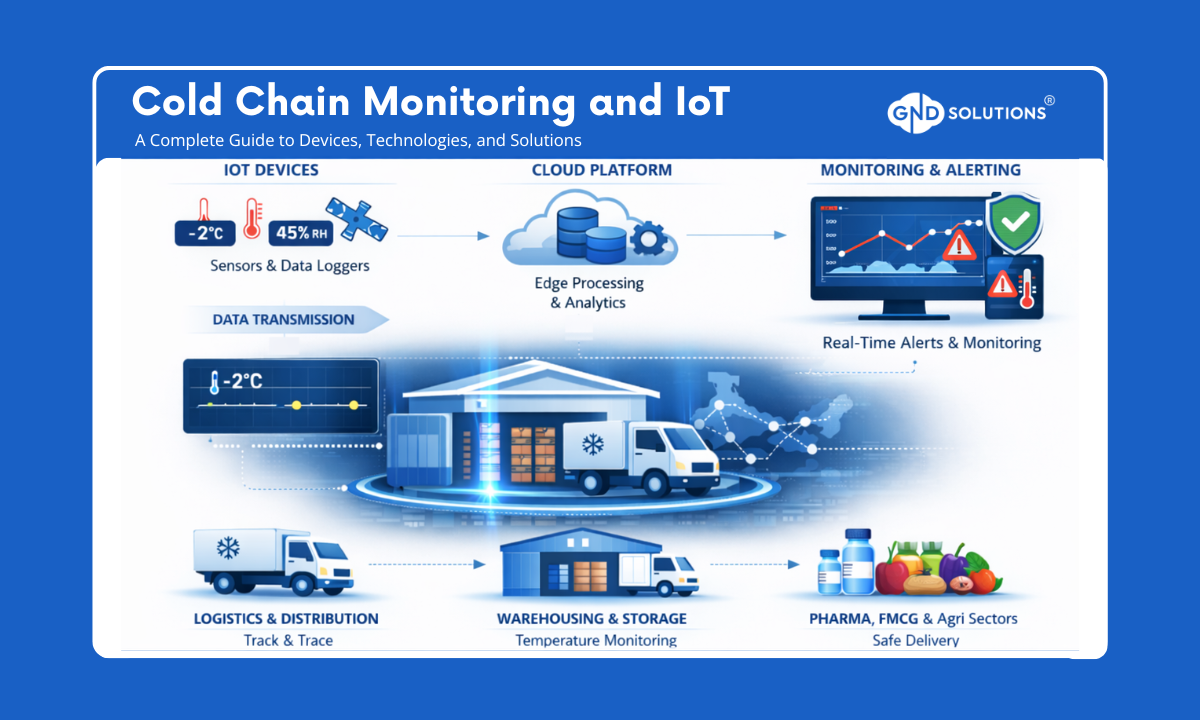
Cold chain monitoring ensures real-time visibility of
temperature-sensitive goods through IoT sensors and
cloud-based platforms.
While traditional systems only track data, GND Solutions
transforms cold chain operations with intelligent, data-driven
decision-making, helping businesses prevent temperature
excursions, ensure compliance, and achieve up to 50% reduction
in losses with complete end-to-end visibility.
What is cold chain monitoring?
Cold chain monitoring is the continuous tracking of
temperature-sensitive products (food, pharmaceuticals) throughout
the supply chain using IoT sensors and data loggers. It ensures
product integrity, regulatory compliance, and reduces waste by
providing real-time alerts for temperature deviations. Inefficient
monitoring contributes significantly to global food waste, which
accounts for nearly one-third of total production.
What are cold chain monitoring devices?
Cold chain monitoring devices are IoT-enabled sensors, data
loggers, and GPS trackers that continuously track the temperature,
humidity, and location of perishable goods during transport and
storage. These devices provide real-time alerts for deviations to
prevent spoilage of pharmaceuticals, vaccines, food, and
beverages. Common technologies include USB data loggers, Bluetooth
Low Energy (BLE) sensors, and NFC cards.
What are the 4 components of the cold chain?
The 4 components of the cold chain are storage, packaging,
transportation, and management. Storage involves refrigerated
warehouses or vaccine fridges; packaging includes thermal
containers and dry ice; transportation utilizes reefers and
insulated trucks; and management encompasses the monitoring
systems and protocols that ensure end-to-end product safety.
What are cold chain monitoring solutions?
Cold chain monitoring solutions are integrated platforms that
combine hardware (IoT sensors) and software (cloud-based
dashboards) to provide end-to-end visibility of environmental
conditions. These solutions automate data collection, generate
compliance reports, and trigger instant notifications if
temperatures drift outside of pre-set safety limits. Real-time IoT
monitoring can reduce spoilage by up to 50% and significantly
improve response times.
What are temperature and humidity data loggers?
Temperature and humidity data loggers are electronic devices used
to record environmental conditions over a specific duration. These
loggers are often placed inside shipping containers to provide a
historical audit trail of the journey, ensuring that goods like
fresh produce or clinical samples remain within safe parameters.
What are IoT-based wireless sensors for cold chain?
IoT-based wireless sensors are advanced tracking devices that use
cellular, Wi-Fi, or LoRaWAN connectivity to send live
environmental data to the cloud. Unlike traditional loggers, IoT
sensors offer real-time visibility, allowing logistics managers to
intervene immediately if a cooling unit fails during transit.
Real-time IoT monitoring can reduce spoilage by up to 50% and
significantly improve response times.
What are RFID temperature sensors?
RFID temperature sensors use radio frequency identification to
transmit thermal data wirelessly to a reader. These tags allow for
high-speed data collection at distribution centers, where workers
can scan entire pallets of temperature-sensitive goods instantly
without opening the packaging, reducing manual logging efforts by
up to 90%.
What are GPS-based cold chain trackers?
GPS-based cold chain trackers are multi-functional devices that
monitor both the physical location and the internal temperature of
a shipment. By combining location intelligence with thermal data,
companies can optimize routes, predict arrival times, and identify
exactly where a temperature excursion occurred, which is critical
since a single pharma breach can result in millions of dollars in
losses.
What are Bluetooth Low Energy (BLE) sensors in cold chain?
Bluetooth Low Energy (BLE) sensors are low-power wireless devices
that transmit temperature data to a local gateway or smartphone.
These sensors are ideal for monitoring internal truck temperatures
or "last-mile" deliveries because they offer long battery life and
seamless integration with mobile apps, ensuring that up to 20% of
pharmaceuticals compromised in transit are better protected.
What are smart refrigerated containers (reefers)?
Smart refrigerated containers, or reefers, are large shipping
units equipped with integrated IoT controllers that autonomously
adjust cooling levels. These units monitor fuel consumption and
report health status to cloud platforms, ensuring large-scale food
and pharmaceutical shipments remain stable across oceans and
reducing the 20–30% loss typically seen in perishable goods.
What are cloud-based cold chain monitoring platforms?
Cloud-based cold chain monitoring platforms are centralized
software ecosystems that aggregate data from thousands of IoT
devices for real-time visualization. These platforms provide
automated 21 CFR Part 11 reporting and predictive analytics,
helping businesses move from reactive monitoring to proactive loss
prevention across global supply chains.
What is dry ice and cryogenic monitoring?
Dry ice and cryogenic monitoring refers to the tracking of
ultra-low temperature (ULT) shipments, often reaching temperatures
as low as -196°C. This specialized monitoring is critical for the
storage and transport of mRNA vaccines and biologics that require
liquid nitrogen. Precise ULT monitoring is mandatory to prevent
high-value pharmaceutical batch rejections.
What is AI and predictive analytics for cold chain?
AI and predictive analytics in the cold chain use machine learning
to analyze historical sensor data and identify patterns of risk.
This technology can predict equipment failure or thermal "hot
spots" before they happen, allowing companies to transition to
"Cold Chain 4.0" and avoid the disruptions that contribute to
one-third of global food waste.
What is 21 CFR Part 11 temperature monitoring?
21 CFR Part 11 temperature monitoring refers to the FDA's
regulatory requirement for electronic records and signatures to
ensure data integrity. Compliance ensures that all temperature
data collected is accurate, reliable, and tamper-proof, serving as
a "legal record" that protects the safety of medications and
vaccines throughout the distribution cycle.
What are the types of cold chain monitoring devices?
There are five primary types of cold chain monitoring devices:
Real-time Monitoring Systems, Data Loggers (USB/PDF), BLE Sensors,
NFC Data Cards, and Fixed Monitoring Systems. Choosing the right
mix of these devices can reduce spoilage and losses by 30–50% by
ensuring the correct technology is used for each specific
environment, from deep-freeze warehouses to last-mile delivery
vans.
What environmental and operational parameters do GND Solutions
cold chain devices monitor?
GND Solutions cold chain devices are advanced IoT-enabled sensors
engineered to continuously monitor critical environmental and
operational conditions throughout the supply chain. These devices
capture key parameters including temperature, humidity, ambient
light exposure, shock/movement, and real-time location (GPS),
ensuring complete visibility of product handling and transit
conditions.
What are the key features of GND Solutions TF8 BLE
Sensors?
GND Solutions TF8 BLE Sensors feature internal memory capable of
storing up to 11,000 records, ensuring reliable data logging even
during connectivity interruptions. This enables a continuous,
gap-free audit trail, which is critical for pharmaceutical and
food safety compliance.
What is the GND Solutions TF10LP LoRaWAN Sensor?
The GND Solutions TF10LP LoRaWAN Sensor is a long-range,
battery-powered IoT device designed for monitoring temperature and
humidity in industrial and cold chain environments. It leverages
LoRaWAN connectivity to enable low-power, long-distance
communication, with a range of up to 2000–3000 meters under
line-of-sight conditions, depending on deployment scenarios. Its
robust, industrial-grade design and IP66-rated enclosure make it
suitable for warehouses, cold storage, pharmaceutical facilities,
and industrial environments. The device supports configurable
sampling intervals, remote configuration, and reliable data
transmission, enabling centralized monitoring across large
facilities. By reducing the need for dense communication
infrastructure, the TF10LP helps optimize deployment costs, while
ensuring continuous environmental monitoring and regulatory
compliance.
What is the GND Solutions IoT Edge Gateway (GBLG100LW)?
The GND Solutions IoT Edge Gateway (GBLG100LW) is a
high-performance connectivity device that acts as a bridge between
wireless sensors and cloud platforms, enabling seamless data
transmission and centralized monitoring. It supports connectivity
for up to 50 BLE sensors or 210 LoRa sensors, making it suitable
for scalable industrial and cold chain deployments. The gateway is
equipped with an internal battery backup of up to 10 hours,
ensuring continued operation during power outages. It also
features onboard data storage (datalogger mode), allowing data to
be buffered locally during network interruptions and synchronized
with the cloud once connectivity is restored. With 99.95% data
assurance, along with support for multiple connectivity options
such as BLE, LoRa, LTE, and Wi-Fi, the gateway ensures reliable,
continuous monitoring across warehouses, pharmaceutical
facilities, and industrial environments.
What is GND Solutions' "Chip-to-Cognition" IoT approach?
GND Solutions’ chip-to-cognition approach provides end-to-end
management of the IoT lifecycle, from custom hardware design to
AI-driven cloud analytics. This holistic stack allows businesses
to transform raw sensor data into "Risk Intelligence," enabling
proactive decisions that minimize spoilage and maximize supply
chain ROI.
How to choose a cold chain monitoring solution?
Choosing a cold chain monitoring solution involves evaluating its
ability to provide real-time visibility, regulatory compliance
(GDP/FDA), and automated alerts. An effective solution should
combine high-precision IoT sensors with cloud-based dashboards to
ensure end-to-end tracking across storage, transportation, and
last-mile delivery
What should you look for in IoT sensors?
IoT sensors for cold chain monitoring should offer high accuracy
(±0.3°C), reliable connectivity (BLE/LoRaWAN), and long battery
life. Critical features include internal storage for data backup
during connectivity gaps and industrial durability ratings such as
IP65 or IP66 for harsh environments.
What happens when cold chain monitoring fails?
When cold chain monitoring fails, temperature excursions go
undetected, leading to product spoilage, compromised quality, and
high-value losses. Failure results in significant financial
impact, with industry estimates suggesting that up to 20% of
temperature-sensitive pharmaceuticals are compromised due to
inadequate monitoring.
How much loss does temperature excursion cause?
Temperature excursions cause high-value losses for pharmaceuticals
and food, with studies indicating that up to 20–30% of perishable
goods are lost due to cold chain inefficiencies. In the
pharmaceutical sector, a single temperature breach can result in
losses worth thousands to millions of dollars per shipment and
lead to mandatory batch rejections.
What is the "Compliance Cliff" of 2026 in the cold chain?
The 2026 Compliance Cliff refers to the convergence of new energy
efficiency mandates and stricter electronic track-and-trace
requirements. Companies must adopt advanced IoT systems to meet
these rising global standards for data integrity and carbon
footprint reduction.
BLE vs. LoRa vs. Cellular: Which is best for cold chain
monitoring?
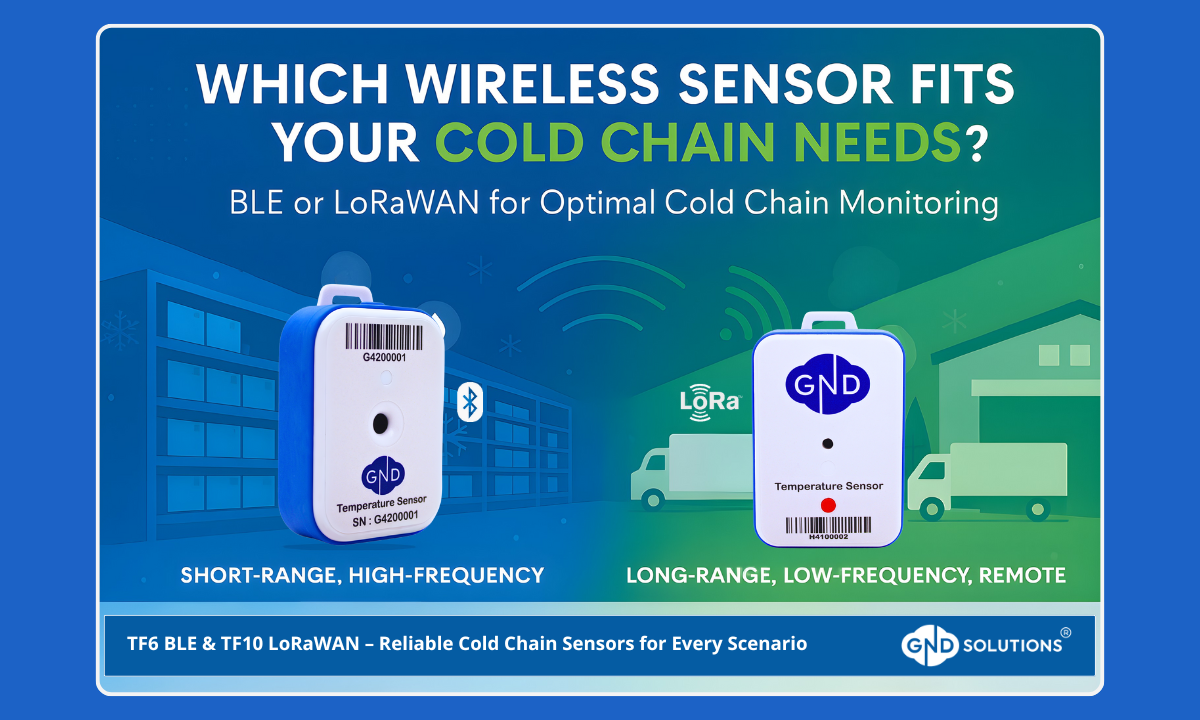
The choice between BLE, LoRaWAN, and cellular connectivity depends
on the specific range, power, and infrastructure requirements of
the use case. BLE is ideal for short-range, energy-efficient
monitoring in last-mile delivery; LoRaWAN offers long-range (up to
2km+) communication for large warehouses; and cellular (4G/LTE)
provides wide-area coverage for in-transit tracking across
countries.
IoT sensors vs. data loggers: What’s the difference?
IoT sensors and data loggers differ primarily in data
transmission: loggers record data for post-trip analysis, while
IoT sensors transmit data in real time via wireless connectivity.
While data loggers are useful for simple audits, IoT sensors are
essential for risk prevention, as they enable immediate
intervention during temperature excursions to prevent product
loss.
What is the cost of a cold chain monitoring system?
The cost of a cold chain monitoring system varies by scale and
technology, but the total cost of ownership (TCO) is often lower
than traditional methods due to reduced labor and product waste.
Automation reduces manual logging efforts by 70–90%, and the
prevention of even one high-value pharmaceutical excursion can
often pay for the entire system's deployment.
What is the ROI of IoT in cold chain monitoring?
The ROI of IoT in cold chain monitoring is achieved through a
30–50% reduction in spoilage, improved regulatory compliance, and
40% faster response times to thermal events. By moving from
reactive to proactive monitoring, companies protect their brand
reputation and avoid the financial penalties associated with
shipment rejections.
How does IoT enable end-to-end visibility in the cold
chain?
IoT enables end-to-end visibility by unifying sensors, gateways,
and cloud platforms into a single "Source of Truth" for
environmental data. This integrated system tracks products from
the manufacturing plant through the warehouse and onto the
last-mile delivery vehicle, providing stakeholders with total
transparency and 99.95% data assurance throughout the journey.
Explore more
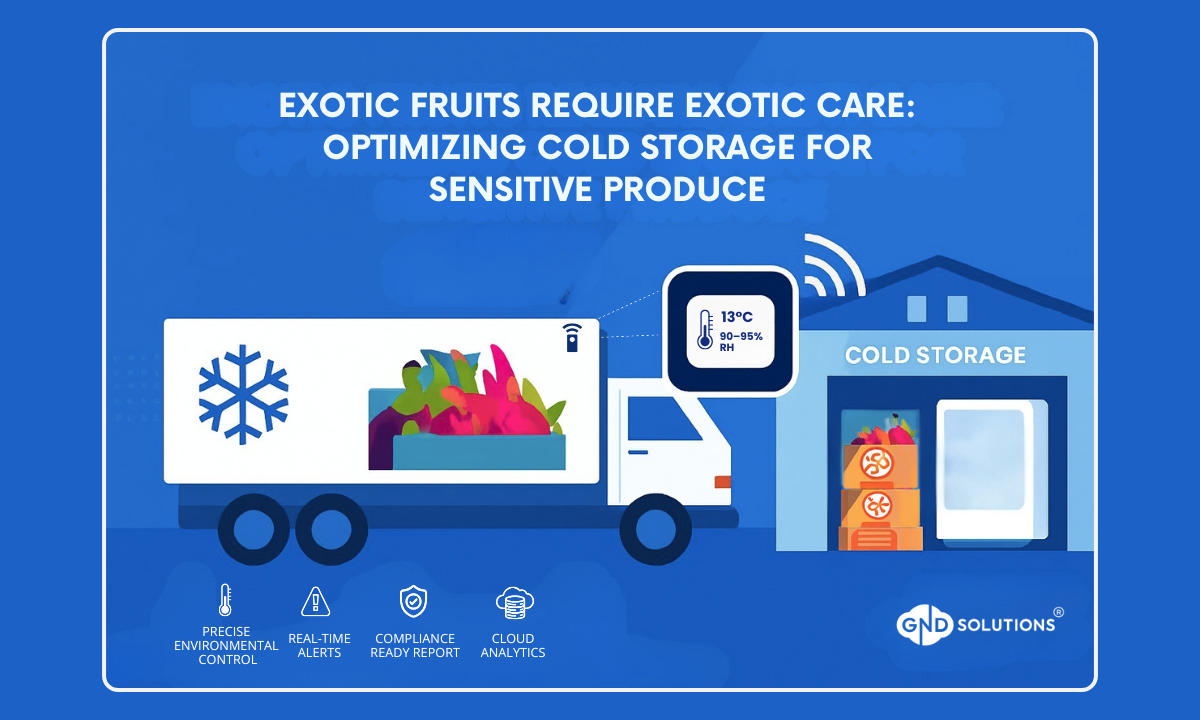
Exotic Fruits Require Exotic Care: Optimizing Cold Storage for
Sensitive Produce
Smart Monitoring for Airport Cargo and Perishable Logistics
Which Wireless Sensor Fits Your Cold Chain Needs: BLE or LoRaWAN?
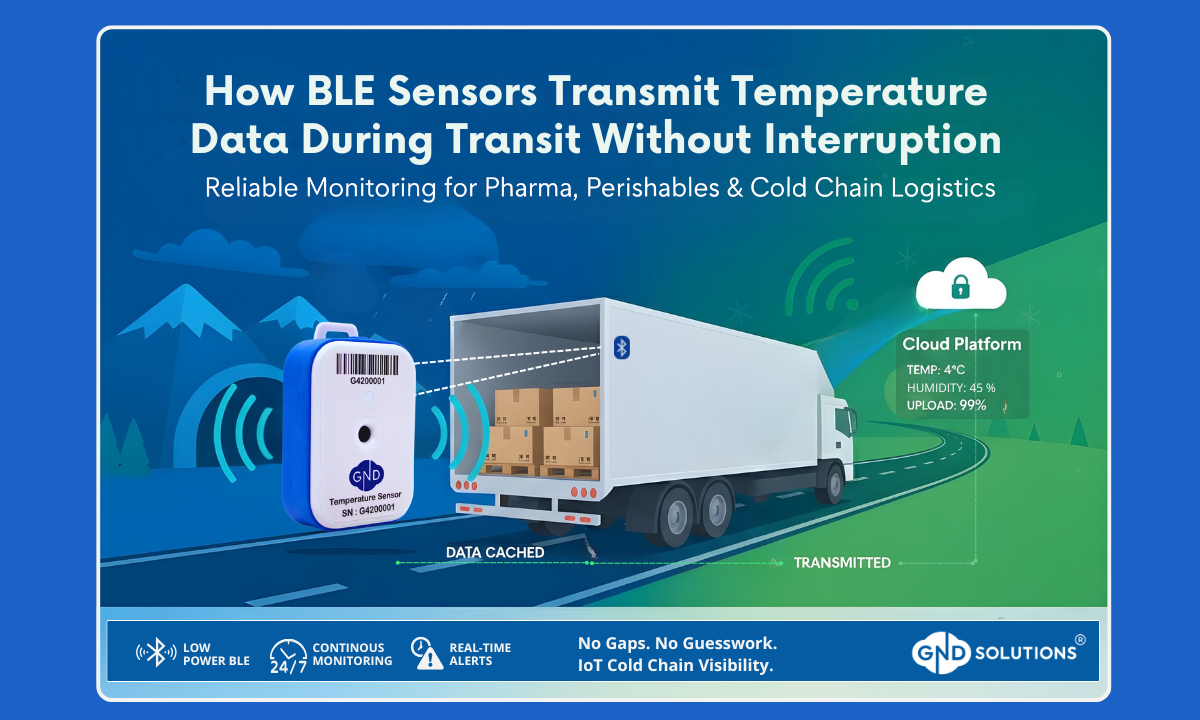
How BLE Sensors Transmit Temperature Data During Transit Without
Interruption
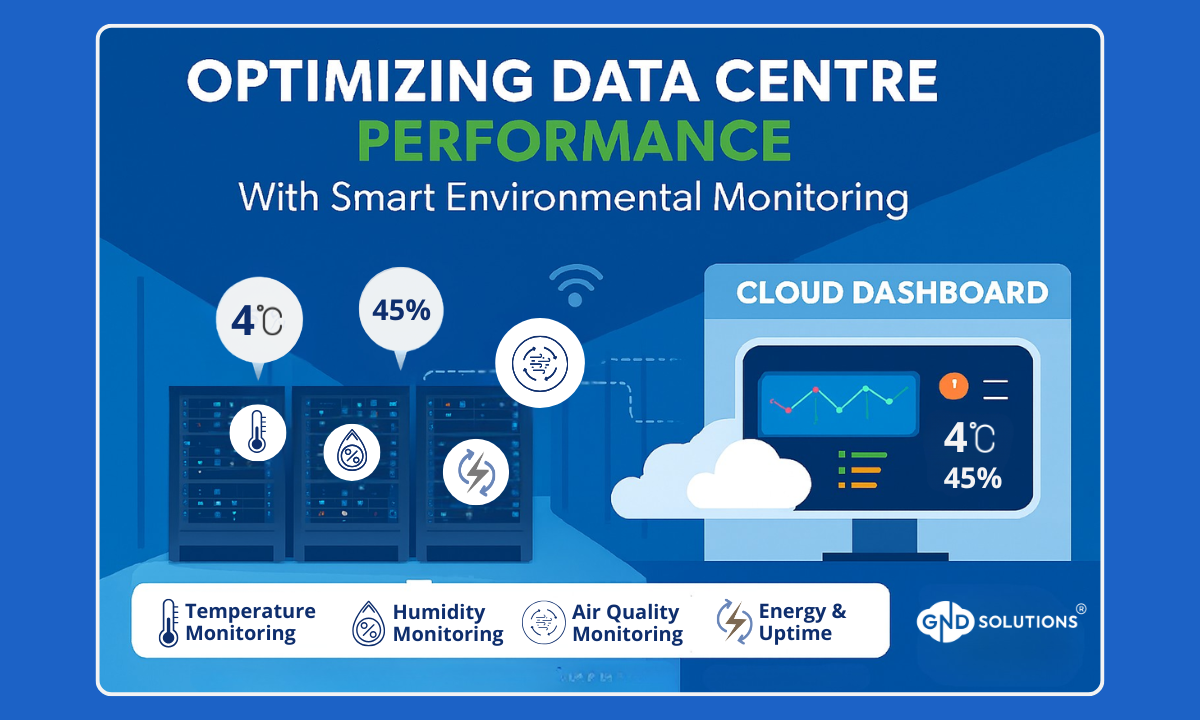
Optimizing Data Centre Performance with Smart Environmental
Monitoring
Meet the GND Solutions Team at Fruit Logistica 2026
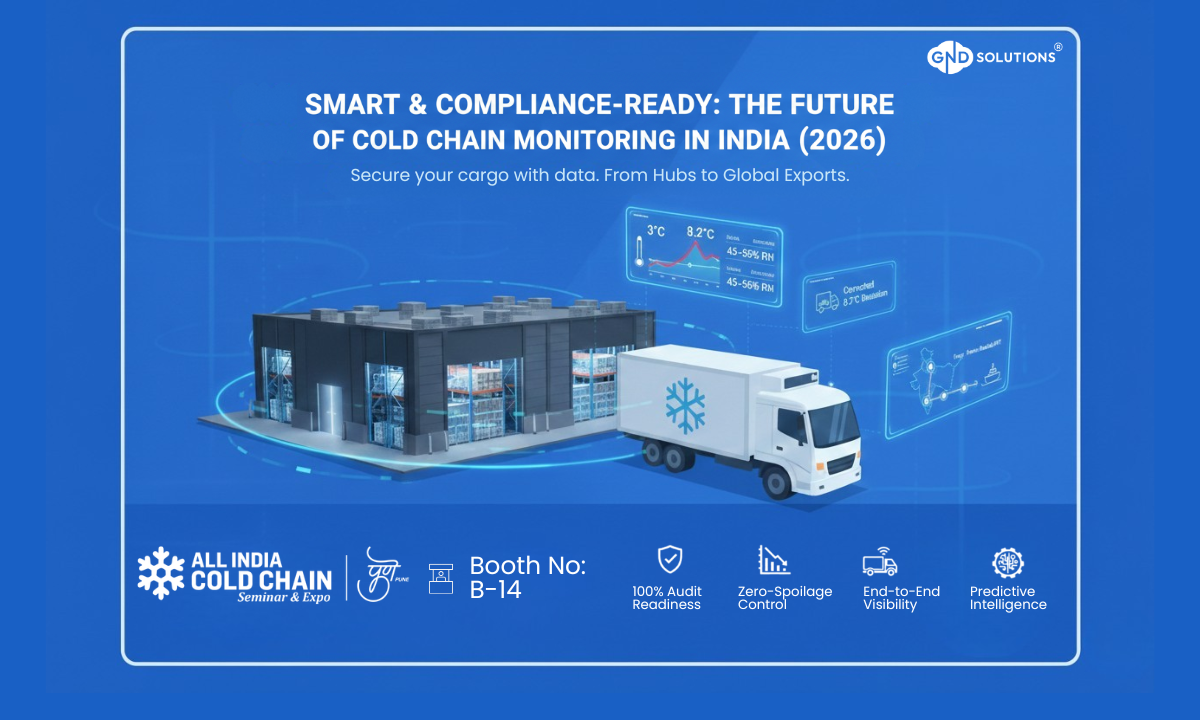
Smart & Compliance-Ready: The Future of Cold Chain Monitoring in India (2026)
Request a Demo
Fill in the details and our team will connect with you shortly.
Thank you!
Your demo request has been received. Our GND specialist will contact
you within 24 hours.